
America's First Daughter: a Testimony to why Feminism is Crucial to the Survival of Women Everywhere
A long title for a long book, both important reads.

This book was the May pick for a book club that I tried out, but will ultimately not attend again. I’m glad I stuck with this book, and I never would have found it if not for that list by the aforementioned club. If this is on your TBR, I must warn you now that this post will contain spoilers.
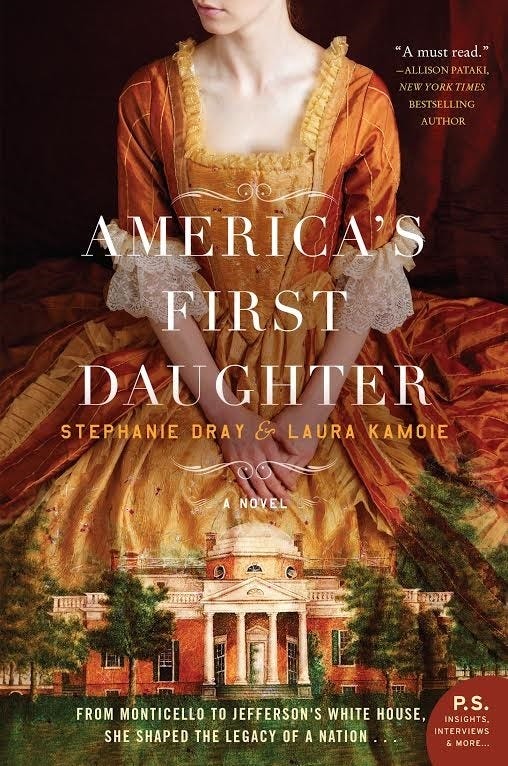
I’ll keep this short, sweet, and to the point: this is ultimately a book about the many sufferings and sacrifices of women everywhere. And Patsy Jefferson is our everywoman in this tale, serving as the dutiful eldest daughter, the faithful wife, the brave mother, and then the strong grandmother with the shiny spine she acquired — and could only acquire — through her many hardships, and the hardships of the women around her.
Despite the progress and triumphs of the men around her, Patsy’s place and power over her own life is not something she can take into her own hands. In the time she lived, all women were to marry, because they could be nothing else but a Mrs. Your best shot at building a life that you deemed worth living was if you married the man wealthy enough to care for you and your many, many children, that you would have whether you liked it or not.
In this novel, not only do we get a glimpse into the sparse medical care that women were given (and, let’s be frank, still receive,) that included very little actual medical intervention, and more “here’s what we can do to like. Dull the pain, but other than that, you’re a goner because your body couldn’t handle childbirth. lol sorry”. Patsy’s mother suffered and died this way, from complications during childbirth, and later on her sister Polly suffers the same fate because her husband simply couldn’t be bothered to see his wife as more than breeding stock, despite his claims to love her. Patsy survives by not inheriting her mother’s structure, but in the end suffered immensely beneath the weight of the loss of Polly in childbirth, and her youngest sister to one of the many diseases that took so many children in those times, and are now taking children again as we see a rise in anti-vax parents.
The parentification of Patsy after her mother’s death is something that every eldest daughter will immediately understand. Were it not for her, her father surely would have killed himself in the wake of Martha Jefferson’s death, and had she not sacrificed the joys of childhood to accompany her father and remind him of his reasons for living, she and her sisters would have been orphaned.
Put on a brave face. Don’t cry. Be the grown-up that you need in your life at the tender age of 10. Carry on, and take everything in stride, day by day. Hour by burdensome hour.
Patsy spent her life doing what was best for those around her because it was the only bit of power she had. She could not take charge of her own fate, so she instead acted as the rock in the lives of everyone she loved. It was almost all a woman could do at the time.
She faced domestic violence, rape, and near murder while being trapped in her marriage, and it’s a grim reminder that women today would always be stuck in that same scenario had our mothers and grandmothers and great-grandmothers not fought for the daughters of the future, the women of today.
Patsy’s life was the expected reality 250 years ago. And those were just the hardships that white women faced. Sally’s story is only told in brief glances from Patsy’s perspective, but hers is equally as important.
Women kept as slaves not only faced the same expectations and scrutiny that comes with being a woman, but also faced every prejudice and injustice that comes with being black — and because she was born into a time where black citizens were not seen as people at all meant that she had even less of a chance at holding fast to whatever power she had in steering her own fate. It also meant that there was little she could do for the people around her. Little she could do to protect her children.
Sally, like Patsy, had no say in who took her where, forced to work, coerced into sex by Thomas Jefferson, forced to watch her firstborn die because whatever little could be done for dying white women and infants was not extended to black women and infants. Not only was she forced to watch her baby die, forced to watch the animalistic apathy of the white men who had all the power over her and every other woman, but she could not even grieve her little boy, who was buried in an unmarked grave.
It’s a reminder that while women today have many more opportunities, more adequate access to proper medical care, and have more power over their own lives than ever before, the prejudices that our grandmothers fought against are still crushing the lives and wills of women today.
It’s a reminder that the mortality rate of women has increased since 2019, and that black and native women and children are especially at risk.
It’s a reminder that child marriage is still legal in 34 out of 50 of the United States, and girls like Patsy are married off at 17, at 16, even as young as 12.
It’s a reminder that domestic violence and violence against women is still incredibly prevalent, and with the rise of right-wing extremism and the rejection of progress against climate change, we have also seen an increase in gender-based violence.
And finally, it is a reminder of how quickly the tide can turn. It is a reminder that, despite how daunting things may seem, a chance for a better future will never be completely crushed. Mothers and daughters of today are fighting, and will continue to fight for what is right. The rights of all women everywhere lie in the hands of our sisters around us, and the sun will rise on happier dawns, even if we, like Patsy Jefferson and Sally Henderson, do not live to see them.